

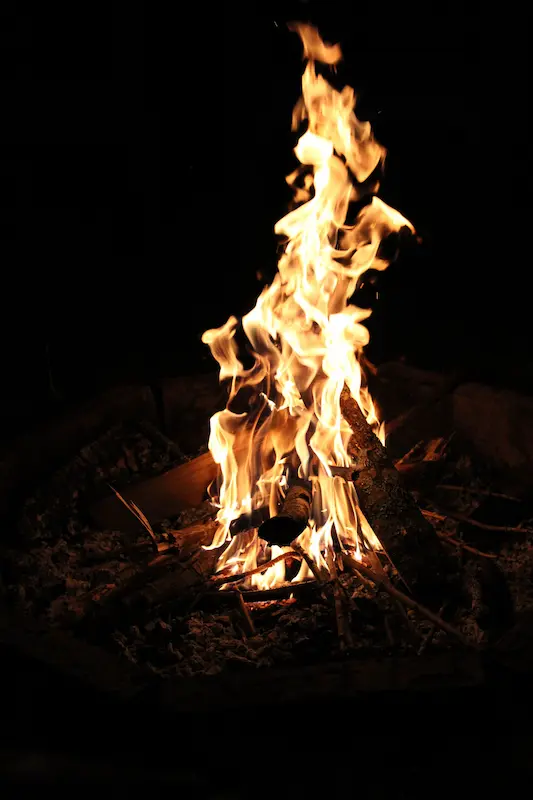
It’s a little past eleven. The stars are out, the marshmallows are long gone, and somebody’s kid has just set the three biggest logs in the woodpile onto the fire with great ceremony. The flames climb. The adults yawn. The tent starts to sound very good. And you find yourself asking the question every camper asks sooner or later about a campfire at night: can I just leave it and go to bed?
A camper on r/camping recently posted a version of that very problem. Their kid had piled wood on the fire a couple of hours earlier, and there they sat, still waiting for it to burn down, so they declared a new camp rule: whoever puts the last log on stays up until the fire is out. The thread passed 300 comments and turned into one of the livelier debates in camping. Plenty of people said, “Just put it out with water.” Plenty of others said, “Well, it depends where you are.” Read through it and you’ll notice both camps have a point, and the gap between them is smaller than it looks.
The Short Answer: Put It Out Before You Sleep
Forestry agencies are consistent on this one. Smokey Bear’s campfire safety guidance says never to leave a fire unattended, and the rule of thumb is easy to remember: “If it’s too hot to touch, it’s too hot to leave.” The advice is to let the wood burn down to ash if you can, then put the fire out completely. A fire that’s still glowing when you zip the tent doesn’t fit that picture, even a small one.
Embers don’t need much of a breeze
Campers in the thread shared a few stories that make the point better than any pamphlet. One described friends sleeping beside a fire in New Brunswick who woke up when the wind shifted and found a stand of cedar trees on the far side of the fire pit burning. Another woke in the night in Colorado to see a trail of fire where the wind had revived a campfire that was supposed to be done. These are one-person accounts, so think of them as stories rather than statistics. But they match what the agencies say: even a light breeze can carry sparks, and a calm evening can turn gusty by 3 a.m. without much notice.
Coals stay hot longer than you’d expect
Flames are only part of a campfire. The real heat sits in the coals, the glowing bed of burned-down wood at the bottom of the fire. A big pile of logs, like the one in the original post, can hold that heat for hours. One commenter figured a fire that size would stay warm until nine the next morning. Safety guides add that coals that look finished can sometimes reignite hours later, which is why “it looks out” isn’t quite the same as “it’s out.”
Why Campers Disagree
Now for the other side, because it’s a real one, and it comes from people who camp a lot.
The “damp air and a small fire” view
Several commenters camp in humid, dew-heavy places, mostly in the eastern U.S. Their routine goes something like this: a well-built fire pit, a modest fire, and wood that has burned down to coals and ash by the time everyone’s ready for bed. Some dig the pit down so the ash keeps the coals contained, then stir them awake in the morning to start breakfast. One commenter who said they used to fight wildfires described the whole question as situational, a matter of where you are and what the conditions are. Another pointed out that in their part of the country, everything is soaked in dew by nightfall.
Where that logic runs out
The trouble is that a habit that works in a damp New England forest doesn’t travel well to the dry West, and advice posted online reaches everyone. Plenty of replies noted that wind, dry brush, and fire restrictions change the math, and a few said that in some places it’s against the rules to leave a fire unattended at all. Others argued that adults are responsible for their own choices. Both reactions are fair.
The takeaway most people could agree on: if you’re not sure what’s safe where you’re camping, ask a ranger or the campground host, and check for fire restrictions before you light anything. As one commenter put it, the local rangers have the final word.
Building a Campfire at Night You Can Actually Walk Away From
Here’s the nice part. Most of the answer comes before the water. These were the best tips in the thread:
- Build the size you need. Smokey Bear’s guide says to keep the fire small, which makes everything after it easier.
- Switch to small wood as the night winds down. One commenter keeps a stash of small splits and sticks for the end of the evening. They burn quickly and help the big smoldering logs finish. It’s the large logs that keep you up.
- Ask “How late are you staying up?” before adding wood. It’s the friendliest etiquette tip in the whole thread, and it costs nothing.
- One fire, one keeper. A camper suggested that every fire have one person in charge of it, which heads off the dreaded “I thought you had it.”
- Put water and a shovel in place before you light. Not after.
Every group seems to have a friend who stacks the wood three feet high, announces “Well, I’m off to bed,” and vanishes. Several commenters recognized him immediately. A kind word around nine o’clock saves somebody a very long night.
How to Put It Out: Drown, Stir, Feel
Smokey Bear’s method is called “drown, stir, drown, feel,” and it works for a reason. Here’s how it goes:
- Let it burn down first. If you can, let the wood burn to ash while you’re still enjoying it.
- Drown it. Pour water slowly over the whole fire pit, covering every ember and not just the red ones. Expect a lot of steam and hissing.
- Stir. Use a shovel or a sturdy stick to mix the ash and coals into a wet, muddy paste (the guide calls it a “mud pie”). One commenter compared it to making soup, and honestly, that’s a good picture.
- Feel. Hold the back of your hand just above the ashes. If you feel any heat, add water, stir again, and repeat. Never touch the coals themselves.
How much water? Campers in the thread said more than you’d think, and one guide citing Forest Service recommendations suggests keeping a bucket and as much as five gallons within reach. Your local ranger office can tell you what they recommend where you’re camping.
What if you’re backpacking and water is precious?
This sparked one of the better side debates. Some campers said they just kick dirt over the fire. Others pointed out that dirt on hot coals can insulate them instead of cooling them, and state forestry officials say that burying hot coals or relying on sand alone is unreliable, since the fire can rekindle. A better plan is to keep the fire small, let it burn all the way down to ash before bed, spread the coals out, and stir them with whatever water you can spare until they’re cool to the touch.
And as one commenter asked: if you can’t easily put out a fire, why have one? On a long hike, a lightweight stove is a perfectly good campfire substitute. In a regular campground, a few commenters swear by propane fire pits, where they’re allowed, for people who want the glow without the babysitting.
The Last Person at the Fire Gets the Best Seat
Here’s what the safety talk can make us forget: that last hour at the fire is one of the best parts of camping. By midnight the flames have settled into a low orange heap, the logs tick as they cool, and woodsmoke hangs in your sleeves and hair. Somewhere past the firelight an owl is asking a question nobody’s going to answer. Several commenters said they volunteer for the last shift every time. One called the fire “caveman TV.” Another said that around a campfire at night, it’s easy to feel for a while like everything is okay, and that’s hard to argue with. If you’re one of the people staying up, bring a wool or cotton blanket, tuck your feet up in the camp chair, and keep the blanket a few feet back from the fire ring, since stray sparks can burn small holes in any fabric.
And about that kid with the giant logs: several commenters suggested the best fix is to keep them up with you and teach them how to drown, stir, and feel for themselves. A small tweak to the original rule might work even better: whoever adds the last log helps put it out. If you’re planning a family trip, our post on a first camping trip with kids has more ideas along those lines.
A Quick Word on Fire Ethics
A few habits keep a campfire at night kind to the place you’re visiting. Use the existing fire ring (the metal or stone circle many campgrounds provide) instead of making a new one. Check for fire bans before you leave home, since one commenter happily reported finally getting a campfire after a whole summer under restrictions. Never burn plastics or foil-lined wrappers. And before you light up at all, take the Leave No Trace approach and ask whether the fire can be fully put out afterward. If you’re cooking over your fire, our beach camping guide has a section on campfire cooking too.
Key Takeaways
- Forestry agencies say a campfire should be fully out before you go to sleep, and “too hot to touch” means “too hot to leave.”
- Campers disagree mostly because conditions differ: damp, small-fire camping isn’t the same as dry, windy country.
- Most of the work happens earlier: build a small fire, switch to small wood late in the evening, and ask how late everyone’s staying up before adding logs.
- Drown, stir, and feel until the ashes are cool to the back of your hand.
- When you’re unsure about local conditions or rules, ask a ranger or campground host.
Recommended Products
Overland Roamer Blanket. A 100% cotton woven blanket with a retro camper van illustration, available in three sizes. The medium works well draped over a camp chair as the evening cools, and the small is an easy lap throw for the last hour at the fire.
Wandering Warrior Blanket. A woven throw with a geometric pattern in terracotta, slate blue, black, and cream, finished with fringed edges. Its earthy palette suits a campsite, and it’s a nice one to pass around when the group settles in for the late shift.
You can browse the full blanket collection if neither fits.
Related Reading
Continue Reading on Tropical Adelie
- How to Make Camping Comfy: Small Upgrades for a Cozier Night Outside
- How to Make Your Campsite Actually Cozy
- First Camping Trip With Kids and 7 Simple Things They Often Learn
- Beach Camping for Beginners: The Small Annoyances and Big Joys
Recommended External Resources
- Campfire Safety, Smokey Bear (U.S. Forest Service wildfire prevention campaign)
- Celebrate Smokey Bear’s 80th Birthday At Wisconsin State Parks, Wisconsin Department of Natural Resources (includes campfire safety reminders)
- Principle 5: Minimize Campfire Impacts, Leave No Trace Center for Outdoor Ethics
Final Thoughts
The campfire debate in that thread was really about two things camping lovers care about at once: staying by the fire as long as possible and leaving the woods exactly as safe as they found it. You can have both. Build it small, burn it down slowly, drown it, stir it, and feel for heat before you head to the tent. Then you can sleep soundly, wake up to cold ashes and a quiet campsite, and put the kettle on for morning. The next time the night is clear and the fire is low, pull your blanket around your shoulders, stay a little longer, and enjoy it.