
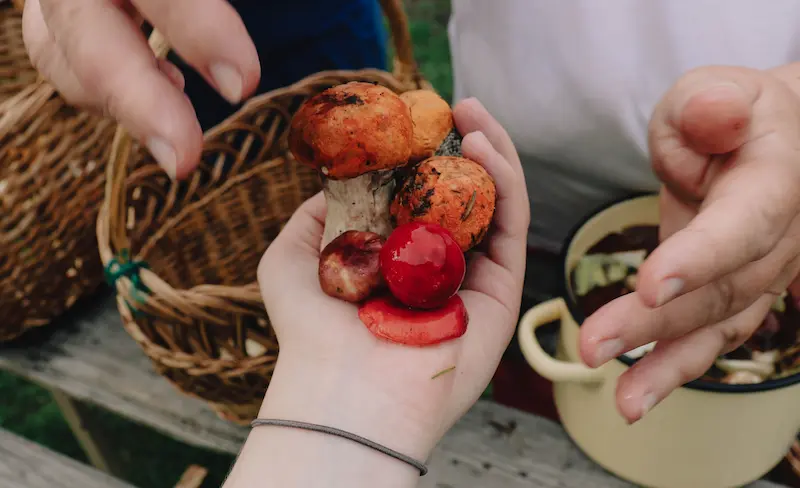
It rained overnight, and now the whole forest smells like wet bark and cold earth. You’re walking slowly down a quiet trail with a coffee still warm in your thermos, and there it is: a small cluster of mushrooms pushing up through the leaf litter, caps still beaded with water. You crouch down, reach out, and stop. Somewhere in the back of your mind is something you read online, that pulling a mushroom out of the ground can tear up the fungus underneath, and now you’re wondering if you’re about to do something you can’t undo.
If that sounds familiar, you’re in good company. Almost every beginner asks this question, and even experienced foragers sometimes disagree about it. Here’s what’s actually going on beneath your boots, what research suggests, and how to pick mushrooms in a way that feels good for you and for the woods.
Why Mushroom Picking Feels So Confusing at First
Spend ten minutes reading foraging forums and you’ll find two camps. One says you should always cut the stem with a knife. The other says you can simply pluck, twist, and go. Both groups tend to sound confident, which doesn’t help when you’re new.
Part of the confusion comes from borrowing ideas from plants. With a tulip or a dandelion, pulling out the roots can end the plant. It’s natural to assume fungi work the same way. They don’t, and once that clicks, most of the worry melts away.
What You’re Actually Picking: Mushrooms vs. Mycelium
The mushroom you see above ground is only one small part of the organism. Most of a fungus lives out of sight as a web of tiny threads called mycelium (pronounced my-SEE-lee-um). That web threads through soil, rotting logs, and buried roots, sometimes across a surprisingly large area. The mushroom itself is the fruiting body, the part the fungus grows when conditions are right in order to release spores.
The apple tree comparison
The easiest way to picture it is an apple tree. The tree is the mycelium, working away year-round. The apple is the mushroom. When you pick an apple, you’re not uprooting the tree. Even if a little bit of stem comes along with it, the tree carries on.
Why one mushroom is a small thing
By the time a mushroom looks perfect enough to photograph, it has often started releasing spores, and it won’t last long anyway. Slugs, insects, and weather usually get to it within days. Taking one or two is a tiny event in the life of a fungus that may have been growing there for years.
That said, this is a “picking a few” conversation. It isn’t a license to strip a patch bare, and we’ll get to that below.
What the Research Says (and What We Still Don’t Know)
A long-term study from Switzerland, published in the journal Biological Conservation, looked at what happens when wild mushrooms are picked year after year. The researchers found that systematic harvesting didn’t reduce later fruiting-body yields or the variety of species in the forest, and it didn’t matter whether the mushrooms were picked or cut. You can read the abstract on ScienceDirect.
It’s reassuring, but it’s honest to say what it doesn’t tell us. It’s one study in one region, and there are thousands of fungal species with different habits. Some, like morels and truffles, are still not fully understood by scientists. So the sensible takeaway is not “anything goes.” It’s that picking a modest amount, gently, is very unlikely to harm the fungus itself.
Cut or Pull? A Simple Way to Decide
Since neither method seems to damage the mycelium, the real question is which one suits the situation. Here’s how experienced pickers tend to think about it.
When cutting makes sense
- The base of the stem is caked with dirt or sand, and you’d rather leave that in the woods than have it spread through your basket. This is a common reason people cut chanterelles.
- You want to keep your hands and your haul tidy while you walk.
- You’re not sure of the species yet and you’re just taking a photo and a note. In that case, you may not need to pick anything at all.
When pulling (or digging gently) helps
- Identification. On some mushrooms, the shape of the very bottom of the stem matters. Certain dangerous species have a cup-like structure called a volva at the base, and it can stay hidden underground if you cut the stem off. If you’re studying a mushroom to figure out what it is, the whole thing tells you more.
- Species that grow deep. With some boletes and other mushrooms, cutting can leave a large part of the stem in the ground.
A note on this: seeing the base of the stem is one clue among many. It’s never enough on its own to decide a wild mushroom is safe to eat.
Check the local rules first
This part surprises many beginners. Some public lands have their own harvesting rules, and they may not match what you read online. For example, the Flathead National Forest in Montana asks harvesters to avoid disturbing the soil and to cut or break mushrooms off at ground level, with no raking or digging. Other forests ask you to slice mushrooms in half at the time of harvest or require free permits. Rules also vary on whether you can pick in developed areas: on the Arapaho and Roosevelt National Forests in Colorado, for instance, mushrooms can’t be gathered in campgrounds, picnic areas, or trailheads. usda
So before you head out, check the website or call the local ranger district. It only takes a few minutes, and it means you’ll be following the rules for the specific place you’re standing in.
A Cozy Foraging Morning: What to Bring
Mushroom picking is at its best when you treat it like a slow morning walk rather than a mission. A few simple things make it easier:
- A basket or open mesh bag. Mushrooms bruise and get slimy in sealed plastic. A basket lets air move around them, and it’s much prettier.
- A small folding knife. Useful for trimming dirty stem bases or cutting where the rules call for it.
- A soft brush. A pastry brush or small paintbrush works well for sweeping off dirt in the field.
- Paper bags or wax paper for separating different kinds, so nothing gets mixed up.
- A camera and a small notebook. Photos of the cap, underside, stem, and the ground around it are helpful for identifying later.
If you want to slow down even further, try sketching what you find. Drawing a mushroom makes you look at the details you’d normally miss, like how the gills attach, the texture of the cap, the little scales on the stem. It’s a lovely way to build your eye for identification, and it turns a quick photo stop into a quiet moment. Here’s a video of the mushroom drawing process to get you started:
Foraging Etiquette: Leave the Woods Better Than You Found Them
Picking gently is only part of being a good guest in the forest. A few habits go a long way.
- Take only what you’ll actually use. If you only need enough for dinner, leave the rest for wildlife and for other foragers.
- Leave the very young and very old ones. Tiny buttons haven’t had a chance to release spores, and past-prime mushrooms are often past eating anyway.
- Walk lightly. Avoid trampling the area around the mushrooms, since that soil is where the mycelium lives.
- Fill in any holes if you do dig, and take your litter with you.
- Ask before picking on private land.
One caring tip about eating
It’s worth being a little cautious here, in the friendliest possible way: don’t eat any wild mushroom until it has been positively identified by someone who knows your local species, like a regional mycological society or a knowledgeable local guide. Apps and photos are useful for learning, but they’re not a substitute. Many edible mushrooms have look-alikes that can make you seriously ill. The Forest Service’s own advice for beginners boils down to something simple: if you’re not sure, leave it where it is.
A Quiet Moment After the Hunt
Some of the best parts of a mushroom morning happen once the picking is done. Spread a blanket at the edge of a clearing or in the shade near your campsite, pour something warm, and lay your finds out to look at them properly. Turn a cap over and see the gills. Compare it to the page in your field guide. Sketch it if you like, or don’t.
A soft blanket makes the whole thing feel less like a task and more like a small ritual. That’s really what foraging is for beginners: a reason to move slowly, pay attention, and be outside.
Key Takeaways
- The mushroom you see is the fruiting body of a fungus. The mycelium lives underground, and picking a few mushrooms doesn’t uproot it.
- A long-term Swiss study found that regular mushroom harvesting didn’t reduce later yields, whether mushrooms were picked or cut, though it covers one region and can’t speak for every species.
- Cutting is handy for cleaning and is required in some places; pulling helps with identification. Follow local rules where you forage.
- Take only what you need, walk lightly, and never eat a wild mushroom until an expert has confirmed it.
Recommended Products
Just Morels Blanket (also available in a Left version). This cream woven throw has a grid pattern with little brown mushroom motifs and dark fringe along the edges. It’s a natural fit for a foraging morning: something to sit on at the edge of the trail, wrap around your shoulders while you sketch your finds, or fold over the back seat for the drive home.
Related Reading
Continue Reading on Tropical Adelie
- How to Make Your Campsite Actually Cozy: small touches for making your camp feel like home after a day out on the trail.
- How to Make Camping Comfy: Small Upgrades for a Cozier Night Outside: easy ways to stay comfortable once the sun goes down.
- Oregon Coast Camping for Beginners: Best Campgrounds to Start With: a gentle place to begin if you’re planning a trip in the Pacific Northwest.
- First Time Solo Camping? Here’s Why Cold Nights Catch Beginners Off Guard: useful if you’re heading out alone for a foraging weekend.
Recommended External Resources
- “Mushrooms,” USDA Forest Service, Olympic National Forest: explains personal-use rules, quantity limits, and basic safety advice for gathering on national forest land.
- “Mushroom Harvest Guide,” USDA Forest Service, Flathead National Forest (PDF): a good example of the kind of harvest rules you may run into, including guidance on cutting or breaking mushrooms at ground level.
- “Mushroom picking does not impair future harvests,” Biological Conservation (abstract on ScienceDirect): the long-term study discussed above.
Final Thoughts
Picking a mushroom isn’t the delicate, high-stakes act it sometimes sounds like online. Fungi are hardier than most of us assume, and the bigger deal is being curious, gentle, and well-informed about what you’re picking and where. Cut it, pull it, or simply admire it and leave it be. Any of those is a fine way to spend a morning. The next time it rains, lace up your boots, tuck a blanket in your pack, and go see what’s come up in the woods.